Showing posts with label Mazda MX-30. Show all posts

Tuesday, April 21, 2020

Mazda Confirms That Rotary Engine Will Return in MX-30 SUV


As part of its 100th anniversary, Mazda has been busy tugging at nostalgia such as coming up with models inspired by the R360 and also highlighting one of its crowning achievements: the mass-production of the rotary engine.

On the surface, the Mazda PR seems innocuous enough, talking about the history of the RX-7. However, there are a couple of lines that stick out and we’ve taken the liberty to highlight it for you below:
“…the company developed a prototype Mazda2 EV with a small single-rotor engine used as a range extender. A similar system could find its way onto the Mazda MX-30...”
Mazda’s continued development of the rotary engine is no secret, but this is the first time we’ve gotten official confirmation from the Japanese carmaker as to its layout and application.

As the company’s first all-electric vehicle, the MX-30 packs an in-house developed battery-driven powertrain called e-Skyactiv. Together with a 35.5-kWh lithium-ion battery, it has a range of about 209 kilometers. Once fitted with the rotary engine as a range extender though, range is expected to more than double. Moreover, Mazda says a rotary engine is perfect as a range extender because it’s quiet, vibration-free, and extremely compact.

Tuesday, March 3, 2020

Mazda Incorporated One Nostalgic Design Detail in the Futuristic MX-30


In a year that sees Mazda celebrate its centenary, the Japanese carmaker is also launching its first-ever all-electric vehicle, the MX-30.

The stylish crossover, fitted with “freestyle doors,” packs a 143-horsepower zero emissions powertrain which Mazda has developed fully in-house called, e-Skyactiv. Together with a 35.5-kWh lithium-ion battery, it has a range of about 209 kilometers.

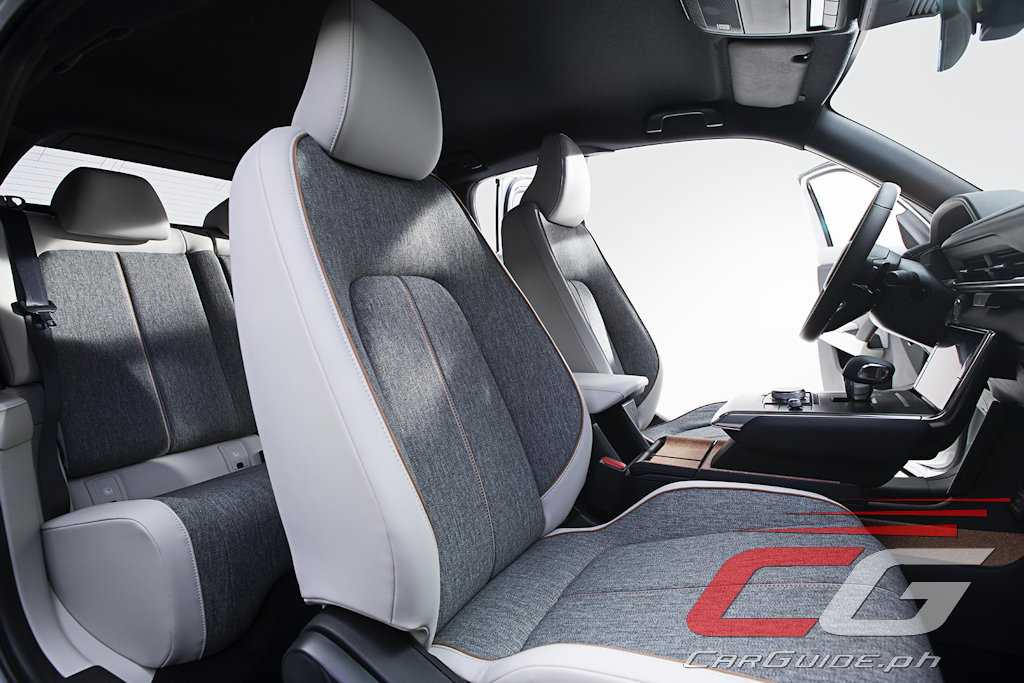
But beyond the newfangled tech in the MX-30, Mazda designers found a way to integrate one design feature that’s a nod to the company’s origins: the cork-lined center console trays and inner side door handles.


Founded in 1920 as the Toyo Kogyo Cork Company, it manufactured cork before Jujiro Matsuda shifted the company’s focus to manufacture tools when the market for cork dried up following the end of World War I. By 1931, the company changed its name to the Toyo Kogyo Co., Ltd and produced the Mazdago motorized tricycle. It was only in 1984 when Toyo Kogyo officially changed its name into Mazda Motor Corporation.

For its use in the MX-30, the cork is harvested from the bark of trees without felling. Moreover, the door trim materials themselves incorporate fibers from recycled plastic bottles.

The sustainable sourcing of interior materials is certainly perfect for Mazda’s first pure electric production car. And as an added bonus, tips its hat to its humble origins as a cork maker.

Thursday, October 24, 2019

No, There's Not a Single Bit of Toyota in the Mazda MX-30


With the launch of their first all-electric vehicle, skepticism started creeping in almost immediately: is the MX-30 a full-blown Mazda or is it something a bit more pedestrian wearing fancy KODO clothing?

According to MX-30 program manager Tomiko Takeuchi, it’s purely a Mazda effort with no influence from Toyota or their collaborative EV joint-venture with Denso, EV C.A. Spirit. Takeuchi-san says the development time line is a full 3 years and 5 months using Panasonic batteries. This technology is officially called e-Skyactiv.


Now, because of Mazda’s Well-to-Wheel approach which takes into account not just what energy source is used, but how it’s generated, they sought for a more balanced approach instead of seeking record-braking range or performance. The battery size was chosen to minimize carbon dioxide emissions throughout its life cycle from resource extraction to battery disposal. Still, the MX-30 has a commendable 209-kilometer range. Moreover, they’re also developing an extended-range EV, too powered by a small rotary engine.

Also, because the MX-30 is a pure Mazda effort, it still aims to deliver the same human-centric design and Jinba-Ittai qualities the brand is known for. Underpinned by the Skyactiv-Vehicle Architecture that underpins the CX-30 and Mazda3, the MX-30’s multi-directional ring structures and its G-Vectoring Control (GVC) system were tweaked to exploit the characteristics and unique qualities of an EV.

Mazda says this helps it realize seamless vehicle motion in all directions, offers a composed ride quality coming from a feeling that the vehicle constantly gravitates toward the road surface, and an intuitive feeling of total control over all operations, including driving, turning, and stopping. Mazda even developed its own unique motor pedal for the MX-30 for seamless performance while offering energy regeneration without waste.


Oh, and as for the sound? Mazda’s e-Skyactiv will provide aural feedback to the driver that enables him to subconsciously recognize the torque status of the power unit, and thus control vehicle speed with greater precision. It’s going to be artificial, but Mazda says it’s based on the human hearing. It’s akin to knowing the amount of water and speed at which it flows based simply on sound frequency and sound pressure.

Finally, why the name MX-30? In Mazda lingo, “MX” means “Motoring Experiment” and with that, they signify rather unconventional cars in the carmaker’s stable. While the most famous one is the MX-5 (Motoring Experiment Project 5) aka the Miata, there have been other MX models too such as the MX-3 and MX-6. It also helps that these MX cars have either/or coupe or roadster body styles—something the MX-30 also has. Meanwhile, the “30” is likely a confirmation of Mazda changing their naming convention for crossovers to two digits starting with the CX-30. Takeuchi-san is also an owner of a first-generation MX-5, so when they learned that the first-ever EV will be called MX-30, they were understandably giddy with excitement.

Tuesday, October 22, 2019

Mazda's First-Ever EV is a Crossover with "Freestyle Doors"


Mazda has unveiled its first mass-production electric vehicle, the MX-30, and despite its rather conventional crossover body, it does have a few design tricks up its sleeve that set it apart from the growing sea of EVs.

A new addition to Mazda's car lineup, the MX-30 is the automaker's third new-generation model after the Mazda3 and CX-30. Aiming to offer an experience that lets customers relax and be themselves and deepens the bond between car and owner, the model offers a creative time and space that invites new ways of using a vehicle.


Under the Car-as-Art ethos, the styling of MX-30 aims to raise its artistic value and expand the expressive range of Mazda's Kodo—Soul of Motion design language. Based on a concept of “Human Modern,” the design stays grounded in the beautifully honed, handcrafted forms of Kodo, yet aligns itself with changing values and new lifestyles.

Spaces in and around the center console give the cabin an open feel, and environmentally conscious materials such as cork and fabrics made from recycled materials are used in ways that bring out their natural appeal, creating a comfortable interior space. In addition, the MX-30 adopts freestyle doors (ala RX-8) so customers can invent new and creative ways of using the car.


In line with the human-centric philosophy, Mazda engineers were determined to deliver the same Jinba-ittai driving joy that every Mazda offers in the EV as well. The model adopts Mazda's new electric-drive technology, e–Skyactiv, and combines outstanding response with smooth dynamic behavior to achieve performance that drivers can enjoy naturally.

“In any era, Mazda wants people to experience exuberant moments in life through cars,” said Akira Marumoto, Mazda's Representative Director, President and CEO at the show. “We will continue striving to deliver creative products and technologies so our customers will love and hold onto their Mazda for a long time.”


Sidebar Title

Main Tab Menu